
The things of the Shilluks are good, and the things of the strangers are bad.
Meaning not yet recorded. Ask an elder what it teaches.
Westermann reports it as a common saying in 1912. Ask Chollo elders for the wording in Dhøg Cøllø.
Chollo (Shilluk)
The Shilluk kingdom, the Nyikang tradition and Upper Nile memory.
A major comparative resource for Northern Lwoo political institutions. The Nyikang tradition is central to Shilluk accounts of kingship. Older ethnography is read alongside the living community’s interpretation.
Other spellings and why
At a glance
The topics in the menu now show what is recorded for South Sudan, together with what all Shilluk homes share. Each record says which it is.
Open the South Sudan pageWhat is known so far, and what still needs research.Nyikang at the centre
The Nyikang tradition is central to Shilluk accounts of kingship. Older ethnography framed it as “divine kingship”, an interpretation that is debated, so the archive reads it alongside the living community’s own account.
Emblem and colour
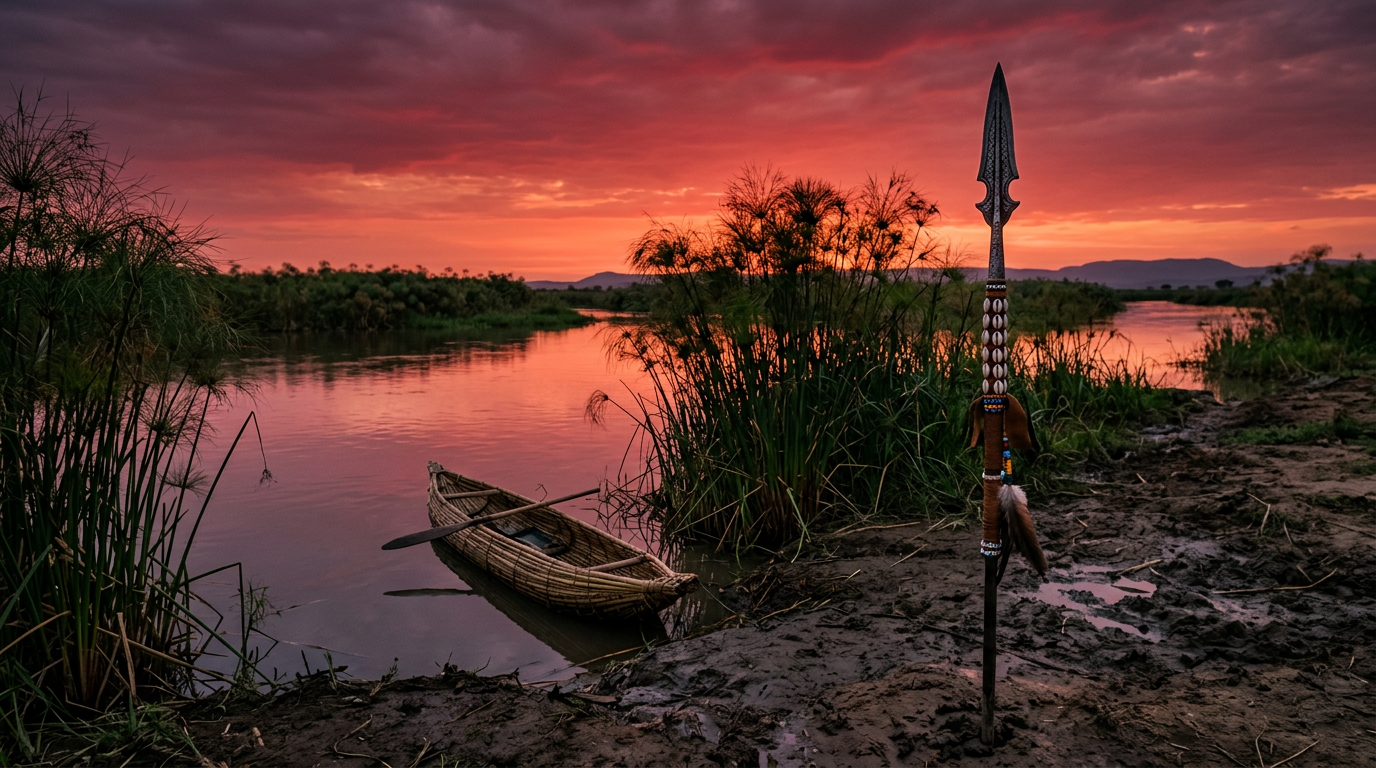
Royal spear and reed boat
Nile-dusk crimson
The ceremonial spear of the kingship and the reed boat of the White Nile, in the crimson of the upper Nile sky.
Questions to ask an elder
Related Luo Nations
The Shilluk are the northernmost Luo people. Their kingdom on the White Nile is dated to the mid-fifteenth century, founded around the culture hero Nyikang, who is remembered as having led his followers north after a quarrel with his brother.
The Päri tradition remembers descending from those who did not follow Nyikang, which links the two peoples.
Encyclopedia summary
Chollo tradition credits Nyikang with founding the kingdom in the 15th century. The year is disputed: one article gives 1454, legend 1490. Westermann called Nyikang the national hero.
Lead to check with South Sudan elders and reviewers.
Encyclopedia summary
Lineages (kwa) trace descent from a common ancestor; more than 100 have been studied. Villages group into settlements (podh) under one leader, each made of hamlets (paj). The royal Kwareth hold the titles reth, nyireth, nyareth and kwar nyireth, and the land is divided into Gher in the north and Luak in the south.
Lead to check with South Sudan elders and reviewers.
Encyclopedia summary
The reth comes from Nyikang’s line, and his wellbeing was bound up with the wellbeing of the nation; royal worship centres on the Nyikang story. The anthropologist Seligman called it sacred kingship. Today the reth is a traditional leader within the state; Kwongo Dak Padiet has reigned since 1993.
Lead to check with South Sudan elders and reviewers.
Historical account · 1912
Homesteads were fenced with sorghum stalks and villages laid out in a circle. The open centre could hold a men’s meeting house and a small shrine to Nyikang or another ancient king.
Lead to check with South Sudan elders and reviewers.
Historical account · 1912
Westermann’s historical accounts came from old men of the royal family, while women told the stories and riddles. His folklore section includes tales such as Hare and Hyena, Starling and Centipede and The Crocodile Hunter, plus war and mourning songs.
Lead to check with South Sudan elders and reviewers.
Encyclopedia summary
Most Chollo are Christian today, some keep the older religion or a mix, and a few are Muslim. Older worship follows rituals tied to the Nyikang story. Church Missionary Society missionaries arrived in the late 19th century.
Lead to check with South Sudan elders and reviewers.
Encyclopedia summary
The Chollo language, Dhøg Cøllø, belongs to the Luo branch of Western Nilotic. Dhøg means both “language” and “mouth”. It shares much vocabulary with Dha-Anywaa.
Lead to check with South Sudan elders and reviewers.
Historical account · 1912
In 1912 Westermann noted a dry season from January to April, rains from June to September and floods from October to December. Soil is black and fertile by the river and poorer inland.
Lead to check with South Sudan elders and reviewers.
Historical account · 1912
Cattle were the main measure of wealth and standing, with around forty names for colours and horn shapes. They were not sold, and were killed only for funerals, weddings, sickness or sacrifices to Nyikang and Jwok. Boys, not women, did the milking.
Lead to check with South Sudan elders and reviewers.
Encyclopedia summary
Estimates disagree: 800,000 to about one million in one article, 1.7 million (2005) in another. Chollo communities suffered attacks in 2010, clashes in 2011 and renewed violence in late 2022.
Lead to check with South Sudan elders and reviewers.
Dhøg Cøllø is a Western Nilotic Luo language that shares much vocabulary with Anyuak.
Read more on WikipediaFounded by Nyikang in the late 1400s, with its capital at Fashoda. The reth (king) was both political and spiritual head. Ottoman-Egyptian raids from 1820 broke its power. Wikipedia’s two articles give different founding dates.
Read more on WikipediaMostly settled farmers who also keep cattle and fish. Wikipedia covers bride-wealth customs and the elected headmen of today.
Read more on WikipediaUpper Nile in South Sudan, mainly on the west bank of the White Nile, with some communities on the east bank.
Read more on WikipediaThe things of the Shilluks are good, and the things of the strangers are bad.
Meaning not yet recorded. Ask an elder what it teaches.
Westermann reports it as a common saying in 1912. Ask Chollo elders for the wording in Dhøg Cøllø.
Chollo (Shilluk)
Respecting what is small; the cost of boasting
The Shilluk collection has not started. Community members, researchers and families can help begin it.
Help start this collection