
Adong med i kom can
“A slap adds to suffering”
Meaning not yet recorded. Ask an elder what it teaches.
Acholi
WAN ACEL · Acholi
KWOThe Living Nile · Acholi
Life remembered. Wisdom carried forward.
Chiefdoms, clans and councils of northern Uganda and South Sudan, remembered place by place.
Acholi history is best reconstructed through the histories of specific chiefdoms, clans, lineages, settlement patterns, oral genealogies and local intellectuals, not through a single national narrative.
Other spellings and why
At a glance
 Acholi in Uganda
Ker Kwaro Acholi, the chiefdoms of the Acholi sub-region, land, livelihoods and the 2024 census.
OpenAcholi in South SudanMagwi County: Pajok, Obbo, Panyikwara, Agoro, Omeyo, Palwar and Magwi, chiefs’ courts and return.
Open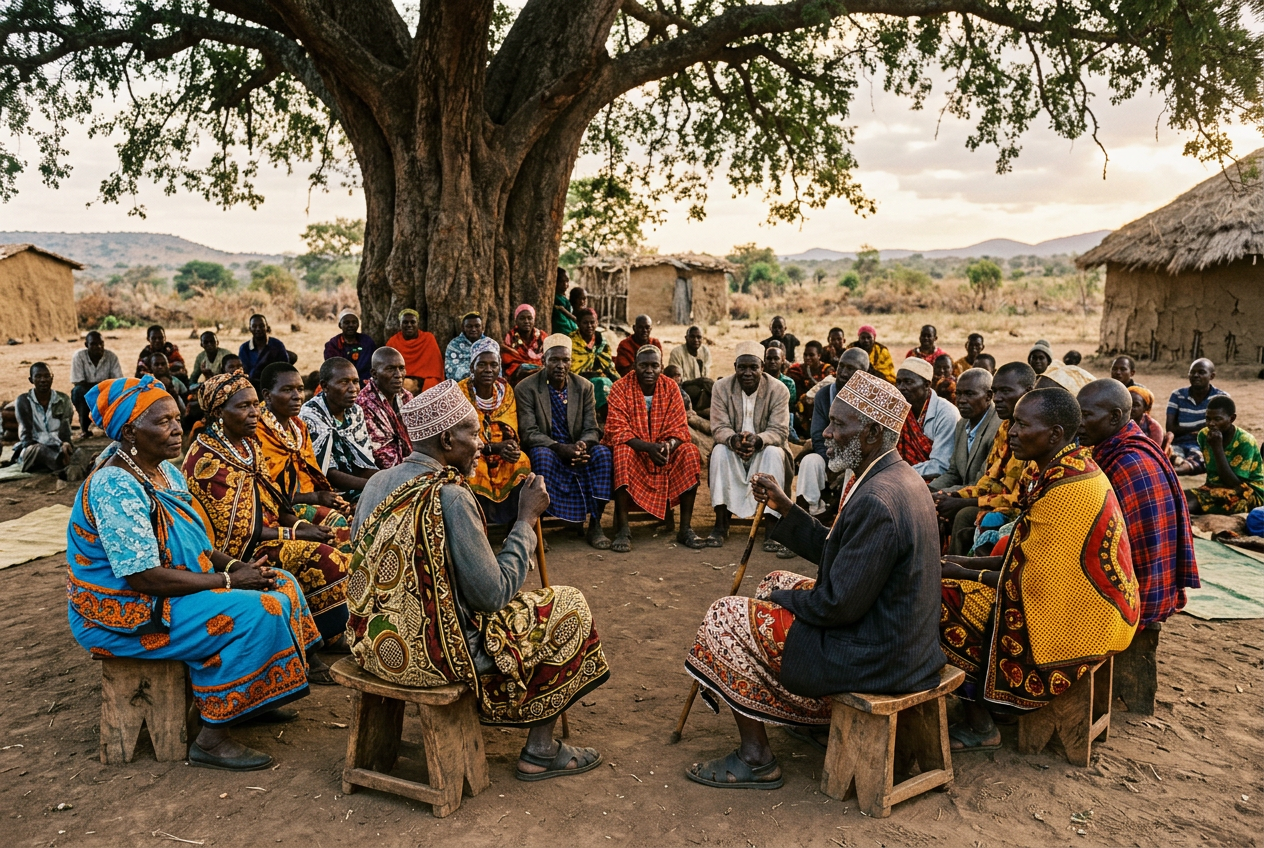 Chiefdoms and clans
18 profiles to grow: roots, tales, history, rituals, coronations, land and resources.
Open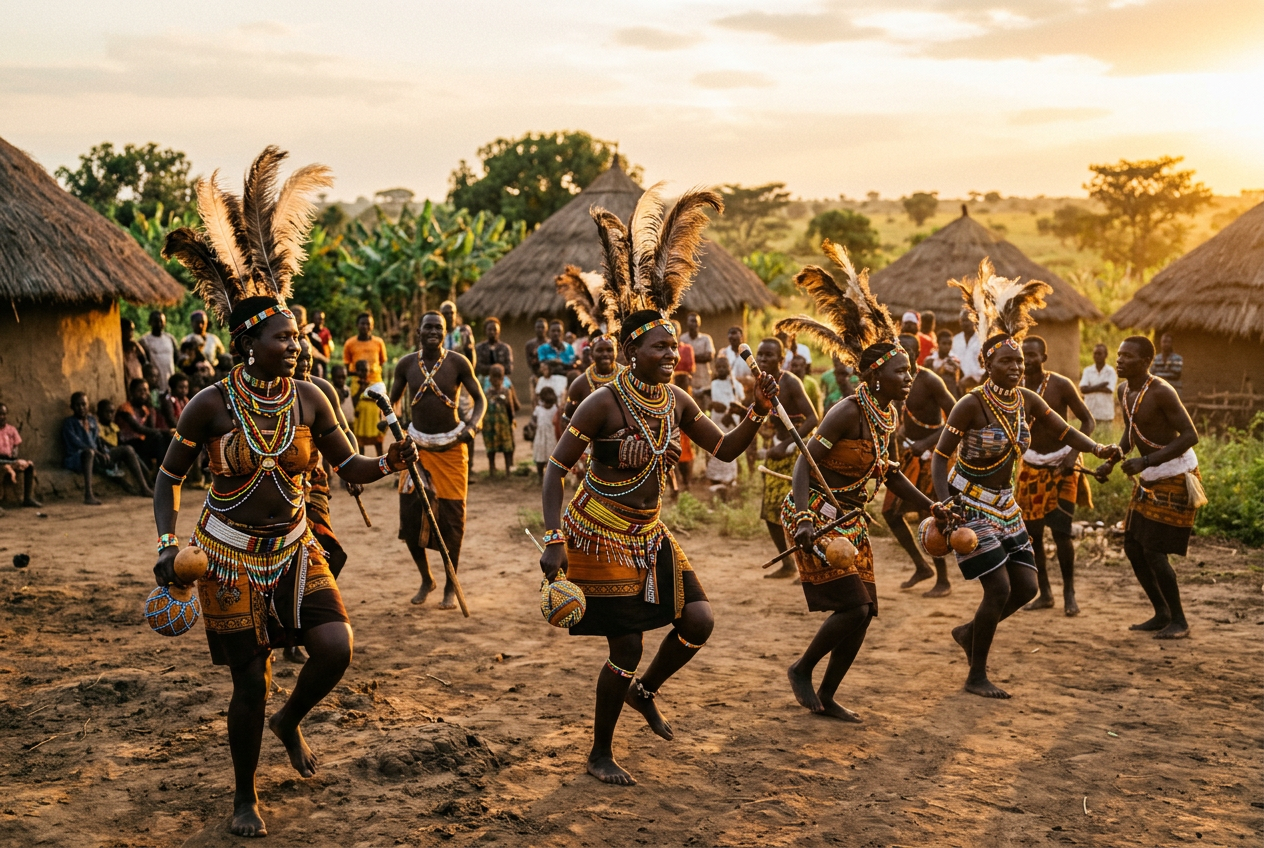 Acholi in the diaspora
Pick your country, province and city for settlement, jobs, business, halls, grants and templates.
OpenAcholi communities live on both sides of the Uganda and South Sudan border and share language, ancestry, customary institutions and much of their way of life. Families intermarry across the border and many have lived on both sides during war and displacement.
The colonial border through Acholi land was first mapped in 1913 and fixed in 1914 and 1926. Only a small part of it was ever surveyed and marked, so the line on the map and the line people live by do not always match.
One identity, many chiefdoms
Acholi history is best reconstructed through specific chiefdoms, clans, lineages and settlement patterns rather than one national story. Each rwot (chief) and each clan carries its own account of arrival, alliance and succession.
Scholars debate how far a shared Acholi identity grew from precolonial ties and how far colonial administration consolidated it. The archive keeps both readings visible and does not settle the debate for you.
Emblem and colour
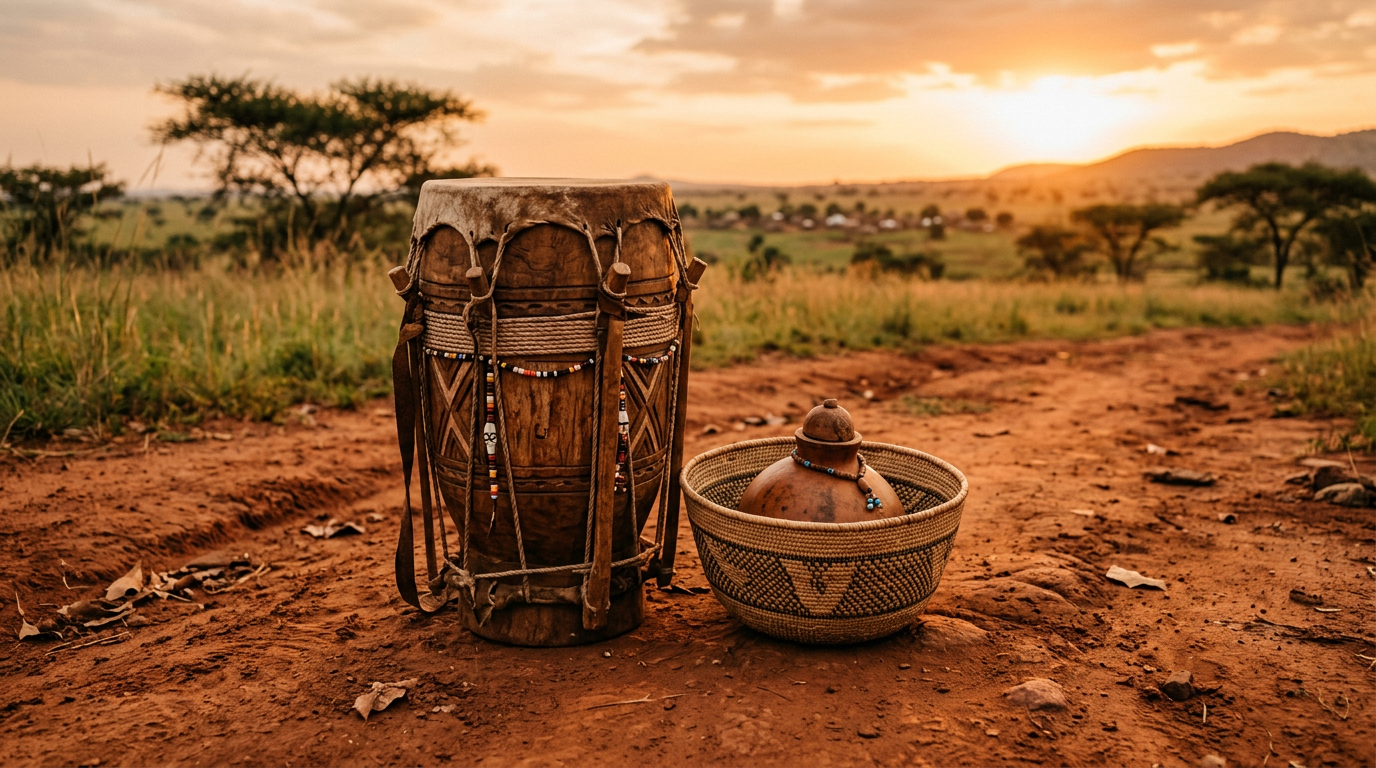
Bwola drum
Red-earth terracotta
The drum that leads the bwola court dance, set against the red earth of the Acholi homelands and the fired clay of their pots.
Words to begin with
Questions to ask an elder
The Acholi are a Nilotic Luo people. Their ancestors are said to have moved south from the Bahr el Ghazal area of present-day South Sudan, reaching northern Uganda over several centuries.
From the late seventeenth century, chiefdoms led by rwodi formed among Luo-speaking clans in northern Uganda. The name “Acholi” itself came into wider use in the nineteenth century.
Shared by all homes · Encyclopedia summary
Wikipedia says the presumed ancestors of the Acholi moved south from the Bahr el Ghazal area of South Sudan into northern Uganda by about AD 1000, but hedges the claim. Encyclopedia.com says the earlier people of the area were mostly Central Sudanic speakers in the west and Eastern Nilotic speakers in the east, with Luo speakers on the edges until the late 1600s. It also notes that Uganda and South Sudan Acholi have partly separate histories.
Lead to check with community elders and reviewers.
Uganda · Encyclopedia summary
Encyclopedia.com credits Luo-speaking Paluo from Bunyoro-Kitara with bringing chiefs (rwodi, singular rwot) who decided matters with lineage heads, tribute paid to the chief, and royal rain drums. About seventy chiefdoms were founded in the late 1600s and 1700s, helped by droughts probably in the 1720s and around 1790. Wikipedia counts about sixty small chiefdoms in eastern Acholi by the mid-1800s.
Lead to check with Uganda elders and reviewers.
Uganda · Encyclopedia summary
Chiefs ruled with a council of clan elders that heard civil and criminal cases and tried to mediate. Colonial rule added appointed chiefs, clerks and police under a district commissioner. A 1995 reform recognised cultural leaders again without returning their old powers.
Lead to check with Uganda elders and reviewers.
Shared by all homes · Encyclopedia summary
Acholi justice put repair before punishment: the families negotiated compensation and then held a reconciliation ceremony, with cleansing rites for homes and people coming back. About 12,000 returning LRA fighters went through nyono tong gweno, stepping on the egg, and leaders at the 2005–2007 peace talks called for mato oput to be revived.
Lead to check with community elders and reviewers.
Shared by all homes · Encyclopedia summary
Drumming, singing and dancing are the main Acholi arts. Royal drums, often linked to rain-making, stood for a chief’s authority, and in most chiefdoms only certain lineages could make or repair them. Possession dances may have come from Bunyoro in the early 1800s, though the source is unsure.
Lead to check with community elders and reviewers.
Shared by all homes · Encyclopedia summary
Encyclopedia.com describes three kinds of spirits (jogi, singular jok): ancestors, the spirit of the chiefdom, and dangerous spirits of strangers and wild beasts, dealt with through possession. Public rites marked birth, planting, harvest and big hunts. Missions spread from the 1910s; Uganda’s 2002 census found about 72% of Acholi Catholic and 24% Anglican.
Lead to check with community elders and reviewers.
Shared by all homes · Encyclopedia summary
Acholi is a Western Nilotic Luo language close to Alur, Dhopadhola and Luo languages of South Sudan. Missionaries produced the first written texts for church and school. Okot p’Bitek’s Wer pa Lawino (Song of Lawino) appeared in Acholi in 1966 before its English version. Many Acholi also speak English and Kiswahili.
Lead to check with community elders and reviewers.
Shared by all homes · Encyclopedia summary
The old staples are finger millet, sorghum, sesame (simsim), peas, beans and leafy greens. Cassava, maize, groundnuts, fruit and cotton came later. Women traditionally grew, processed and cooked most food crops.
Lead to check with community elders and reviewers.
Uganda · Encyclopedia summary
Most Acholi are mixed farmers working with iron hoes, keeping chickens and goats and, in drier areas, cattle. Ironworking, held by certain lineages, may be very old. Since colonial times 10–20% of adult men have been away at any time as labour migrants, police or soldiers. Land was held by lineages; individual titles spread after independence.
Lead to check with Uganda elders and reviewers.
Uganda · Encyclopedia summary · 1996–2009
From September 1996 the government moved people from rural Gulu into camps; the policy grew to cover about a million people in four districts. At one point about 1,000 people a week were dying, mostly of malaria and AIDS. Peace talks from 2005 let some camps close in 2007, but many people were still displaced in 2009.
Lead to check with Uganda elders and reviewers.
Acholi (Leb Acoli) is a Western Nilotic Luo language, close to Alur and Dhopadhola. Okot p’Bitek wrote Song of Lawino in Acholi in 1966 before it was translated into English.
Read more on WikipediaWikipedia traces Acholi ancestors south from the Bahr el Ghazal area. Chiefdoms led by rwodi formed from the late 1600s. It also covers the colonial era, the Amin years and the long LRA war, when many families lived in camps.
Read more on WikipediaChiefs and councils of clan elders kept order through restorative justice. Wikipedia describes mato oput and nyono tong gweno (stepping on the egg), used to welcome people home after the war.
Read more on WikipediaAcholiland in northern Uganda (Gulu, Kitgum, Pader, Amuru, Nwoya, Lamwo, Agago and Omoro districts) and Magwi County in South Sudan, with families in the diaspora. Wikipedia’s population figures disagree with each other.
Read more on WikipediaWikipedia’s Acholi list also names two commanders of the Lord’s Resistance Army. They are not part of this heritage list. The war took a heavy toll on Acholi families, most of whom were its victims; it is covered under History.
Freely licensed photos from Wikimedia Commons, each credited. Captions name only what the file says.
Checking the photo licences…
Adong med i kom can
“A slap adds to suffering”
Meaning not yet recorded. Ask an elder what it teaches.
Acholi
Agulu odiyo otac
“The pot squeezes the head-pad”
Meaning not yet recorded. Ask an elder what it teaches.
Nanetya Foundation records the form “Agulu pii odiyo otac” (“The water pot presses upon the small circular pad”). An Alur form with a stated meaning is shown under Shared across Luo Nations.
Acholi
Akuri ma welo cam neno malo
“A visiting dove eats while watching the sun”
Meaning not yet recorded. Ask an elder what it teaches.
Acholi
Akuri ma welo maro moko i kom kwaka
“A visiting dove is easily trapped”
Meaning not yet recorded. Ask an elder what it teaches.
Acholi
Aling-aling ma kicelo wanga ki cogo?
“Should I keep silent when someone has hit my eye with a bone?”
Meaning not yet recorded. Ask an elder what it teaches.
Acholi
Alunya loyo lakwong
“The follower is more severe than the first”
Meaning not yet recorded. Ask an elder what it teaches.
Acholi
Aming-aming ongolo nge gweno
“The small white ant appears after the chickens have gone to sleep”
Meaning not yet recorded. Ask an elder what it teaches.
Acholi
Ange tyene lit, koko ange
“Regret has sore legs, that’s why it arrives late”
Meaning not yet recorded. Ask an elder what it teaches.
Acholi
Arwot ki oda
“I am a chief in my own house”
Meaning not yet recorded. Ask an elder what it teaches.
Acholi
Atura lipip calo ngok gwok
“Suddenly, like a dog’s vomit”
Meaning not yet recorded. Ask an elder what it teaches.
Acholi
Agwata matek mac aye buko
“Fire breaks the strong calabash”
Meaning: Used of a stubborn person who needs firm correction before they will change.
The meaning comes from an earlier draft whose source has not been traced. The Alur form is explained as “serious problems need serious remedies” (Atido 2011, no. 15). Check against Okot p’Bitek (1985).
Acholi
Lanyap lake pa lyedi
“The lazy person has sharp teeth”
Meaning not yet recorded. Ask an elder what it teaches.
Acholi
Dwong dok
“Plenty of mouths”
Meaning: A gossip or chatterbox.
Acholi
Lit wic
“Pain of the head”
Meaning: Stubbornness.
Acholi
Mit dok
“Sweet mouth”
Meaning: To have a big appetite.
Acholi
Balo wic
“Spoiling the head”
Meaning: To manipulate someone, or to waste their time.
Acholi
Col cwiny
“Darkness of the heart”
Meaning: To wish someone ill.
Acholi
Leng cwiny
“Clean heart”
Meaning: To wish someone well.
Acholi
Tuc ic
“Depth of the stomach”
Meaning: Describes an introverted or taciturn person.
Acholi
Ngic kom
“Coldness of the body”
Meaning: Laziness.
Acholi
Labwor ma kok pe mako lee
“A roaring lion does not catch any prey”
Meaning not yet recorded. Ask an elder what it teaches.
Also no. 53 in the Churchill Ojok list.
Acholi
Giribu pii ma i kulu
“They share only water from the well”
Meaning not yet recorded. Ask an elder what it teaches.
Acholi
Kicaa pa ladit pe dong nono
“An elder’s handbag is never completely empty”
Meaning: An elder always has something left to give, whether advice, experience or a story.
The page gives the translation only. The meaning is from an earlier draft and must be checked with elders.
Acholi
Agoro pe camo kato kulu
“The night ant does not eat beyond the river”
Meaning: Know your limits and work within your own ground.
Acholi
Cok ogwang, iwek gweno
“Chase away the fox, not the chicken”
Meaning: Deal with the real problem, not the innocent.
Acholi
Labolo nywalo too ma neke
“The banana tree bears what kills it”
Meaning: Our own actions, or our own children, can undo us, so act and raise them with care.
Acholi
Kalwok pe doko katwo
Meaning not yet recorded. Ask an elder what it teaches.
The collection gives no literal translation, only “(Do not live by habit)”. Ask an elder for the wording and meaning before use.
Acholi
When two elephants fight, the grass suffers
Meaning: When leaders quarrel, ordinary people pay.
Recorded in English only; told across much of Africa. The Acholi wording is not given.
Acholi
The growing millet does not fear the sun
Meaning: Those rooted in purpose endure hardship.
Recorded in English only. The Acholi wording is not given.
Acholi
The one who asks commits no sin
Meaning: Asking questions is wisdom, not weakness.
Recorded in English only. The Acholi wording is not given.
Acholi
Staying near the anthill turned the antelope brown
Meaning: You become like the company you keep.
Recorded in English only. The Acholi wording is not given.
Acholi
Old and new millet end up in the same mill
Meaning: Young and old share one destiny, so build together.
Recorded in English only. The Acholi wording is not given.
Acholi
The pot of water falls at the door of the homestead
Meaning: Do not relax before the job is finished.
Recorded in English only. The Acholi wording is not given.
Acholi
Visitors, gifts, friends and enemies
A 259-page Peace Corps course in nine units (greetings to family), with a grammar reference, a phrasebook and an Acholi–English glossary.
A four-page historical grammar excerpt on standard orthography, close and open vowels, length, consonants, accent and tone.
A historical synthesis of Acholi identity covering chiefdoms, rwot, jogi, rituals and colonial transformation.
A qualitative case study on clan identity, slogans and riddles, marriage, birth, funerals and post-conflict identity.
A scholarly argument that British administration consolidated many chiefdom identities into a wider administrative ethnic label.
Described in ethnographic research as the culmination of a longer mediation process following a killing between clans that had previously been on friendly terms.
Discussed in ethnographic research as a cleansing ritual associated with people who had killed in war.
An Acoli translation of UN Declaration 53/144, useful for civic and legal terminology.
A 91-page exercise book with an answer key that follows the nine units of the Acholi Language Manual.
A 23-page phrasebook by situation: greetings, occasions, sympathy, school, health, trades, colours, animals and religion.
An 11-page starter booklet: the alphabet, greetings, introductions, meals, directions, lodging and travel.