
Lango
Southern LwooClan structures, women’s voices and a language of north-central Uganda.
A Luo-speaking people of north-central Uganda whose origins are debated: some scholars link the Lango to the Ateker peoples and see a Luo language adopted over time. Research also describes historically decentralised clan structures and how social change has affected women’s roles and rights.
Other spellings and why
- North-central Uganda
At a glance
- Language
- Lango (Leb Lango)
- Linguistic group
- Southern Lwoo, Western Nilotic
- Homeland
- North-central Uganda, around Lira and Apac
- Social structure
- Historically decentralised clans
- Early source
- J. H. Driberg, The Lango (1923)
Lango in Uganda
The topics in the menu now show what is recorded for Uganda, together with what all Lango homes share. Each record says which it is.
Open the Uganda pageWhat is known so far, and what still needs research.About Lango
Clans before kingdoms
Contemporary research describes historically decentralised clan structures. The archive compares oral histories with academic migration narratives rather than choosing one.
Emblem and colour
Ox-horn crescent
Cattle-country ochre
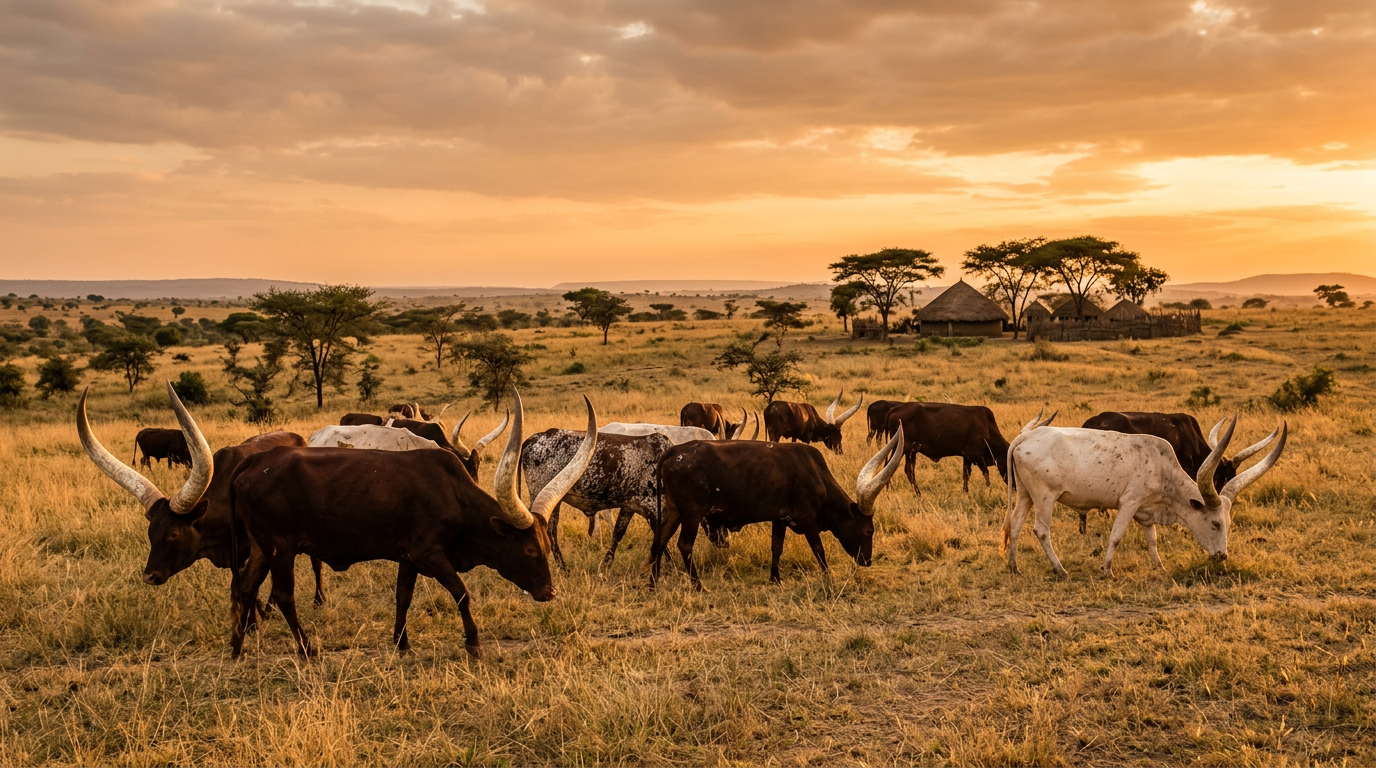
The long-horned ox, central to herding life across the grasslands of north-central Uganda, in the ochre of dry-season grass.
Questions to ask an elder
- Which clan do you belong to, and what is its history?
- Which customs have changed in your lifetime, and why?
Origins
The Lango language is classified as a Luo (Western Nilotic) language. J. H. Driberg, writing in 1923, called the Lango a Nilotic tribe closely related to the Luo.
Other scholars, including G. N. Uzoigwe (1973), argue the Lango share ancestry with the Ateker peoples (Teso, Karamojong, Jie, Turkana), who are Eastern Nilotic, and several authors reject ethnic ties to the Luo. On this view the Lango adopted a Luo-related language while keeping Ateker-linked cultural and social features.
The archive does not settle this. It holds the Lango as a Luo-speaking people with a contested origin, and asks Lango elders and clan leaders how they tell their own history.
History and origins
Encyclopedia summary
Lango oral tradition places their ancestors in a larger group during the migration period, which split before entering Uganda. The name Lango also turns up in the vocabularies of the Teso, Kumam, Karamojong, Jie and Labwor.
Lead to check with Uganda elders and reviewers.
Clans and chiefdoms
Encyclopedia summary
More than 149 clans are registered with the Lango Cultural Foundation. They are united in a cultural institution headed by the Won Nyaci; Michael Moses Odongo Okune is named as the current paramount chief.
Lead to check with Uganda elders and reviewers.
Leadership and justice
Encyclopedia summary
In oral history, fighters were placed under one leader chosen for the campaign, and his authority ended with the war. Remembered leaders include Ongora Okubal, Opyen, Arim Oroba and Agoro Abwango, who died fighting in Bunyoro.
Lead to check with Uganda elders and reviewers.
Music, dance and stories
Encyclopedia summary
Wikipedia names Okeme and Abuda as Lango dances performed at weddings and cultural events, but marks the claim as failing verification. Ask Lango elders and dancers to confirm.
Lead to check with Uganda elders and reviewers.
Beliefs and worldview
Encyclopedia summary
Older Lango belief held that each person has a guardian spirit and a soul, honoured ancestors, and knew a supreme god, Jok. Most Lango today are Christian or Muslim, though older ideas still shape religious life.
Lead to check with Uganda elders and reviewers.
Language
Encyclopedia summary
Leb Lango is classed with the Luo languages. Some writers argue the Lango people have mixed origins and reject a simple Lango-Luo ethnic identity, so both views are kept here.
Lead to check with Uganda elders and reviewers.
Work and livelihoods
Encyclopedia summary
Before colonial rule, unfarmed land could be taken up by any family; once tilled, it belonged to the line of the first farmer and passed to the eldest son. This customary tenure is still common in rural Lango.
Lead to check with Uganda elders and reviewers.
Life today
Encyclopedia summary
The old Lango District was split into Apac and Lira in 1974. The Lango sub-region now covers nine districts, including Amolatar, Alebtong, Dokolo, Kole, Oyam, Otuke and Kwania.
Lead to check with Uganda elders and reviewers.
Quick reads
Language
Lango is closely related to the Luo languages. Wikipedia notes that some authors dispute an ethnic tie between Lango and Luo, so this stays an open question.
Read more on WikipediaHistory
Oral tradition, as Wikipedia reports it, tells of a wider Lango group that split during migration. It names war leaders such as Ongora Okubal, Opyen, Arim Oroba and Agoro Abwango.
Read more on WikipediaClans and culture
Clans come together under the Won Nyaci of Lango. The Lango Cultural Foundation records more than 149 clans. Wikipedia names the Okeme and Abuda dances, though that line carries a “failed verification” tag there.
Read more on WikipediaWhere Lango live
North-central Uganda: Lira, Apac, Oyam, Kole, Dokolo, Amolatar, Alebtong, Otuke and Kwania districts.
Read more on Wikipedia
Notable people
- Milton Obote Second president of Uganda after independence.
- Michael Moses Odongo Okune Paramount Chief of the Lango.
- Jane Aceng Minister of Health of Uganda.Wikipedia marks this line as failing verification.
- Betty Amongi Minister of Gender, Labour and Social Development.Wikipedia marks this line as failing verification.
- Peter Ogwang Minister of State for Sports.Wikipedia marks this line as failing verification.
- Denis Hamson Obua Chief Whip of the Parliament of Uganda.Wikipedia marks this line as failing verification.
- Acen Dorcus Woman MP for Alebtong District.Wikipedia asks for a citation for this line.
- Benes Ayo Communist activist.
What the archive is gathering
- Which traditions are still practised, and which have changed
- Perspectives of women, men, youth, clan leaders and language specialists
- Comparing oral histories with academic migration narratives
Pictures
Freely licensed photos from Wikimedia Commons, each credited. Captions name only what the file says.
Checking the photo licences…
Sayings and proverbs
No sayings recorded yet
We have not yet found a published Lango collection we can cite. Do you know a proverb, riddle or song? A fluent speaker reviews it before it is shared.
Contribute a sayingElders’ teachings
No teachings yet
Teachings grow from Lango sayings. Record an elder with consent in the Youth Lab interview studio.
Prepare an elder interview