

Achero pamunenwa kiyawi
“A gift from an intimate friend is never doubted”
Meaning not yet recorded. Ask an elder what it teaches.
From a single community social media post that tags a book by Prof. Olweny. Check the book.
Jopadhola
A Southern Lwoo people with a lineage-based political history of its own.
A Southern Lwoo community with its own political history. Luo migrants from the north settled in Tororo and over time absorbed Bantu, Iteso and other neighbours into their clans, while keeping the Dhopadhola language.
Other spellings and why
At a glance
The topics in the menu now show what is recorded for Uganda, together with what all Jopadhola homes share. Each record says which it is.
Open the Uganda pageWhat is known so far, and what still needs research.Close language, separate history
Research cited by UNESCO describes a lineage-based system of social and political organisation. Linguistic closeness to Acholi does not make the Jopadhola an Acholi subgroup, and the archive keeps them separate.
Emblem and colour
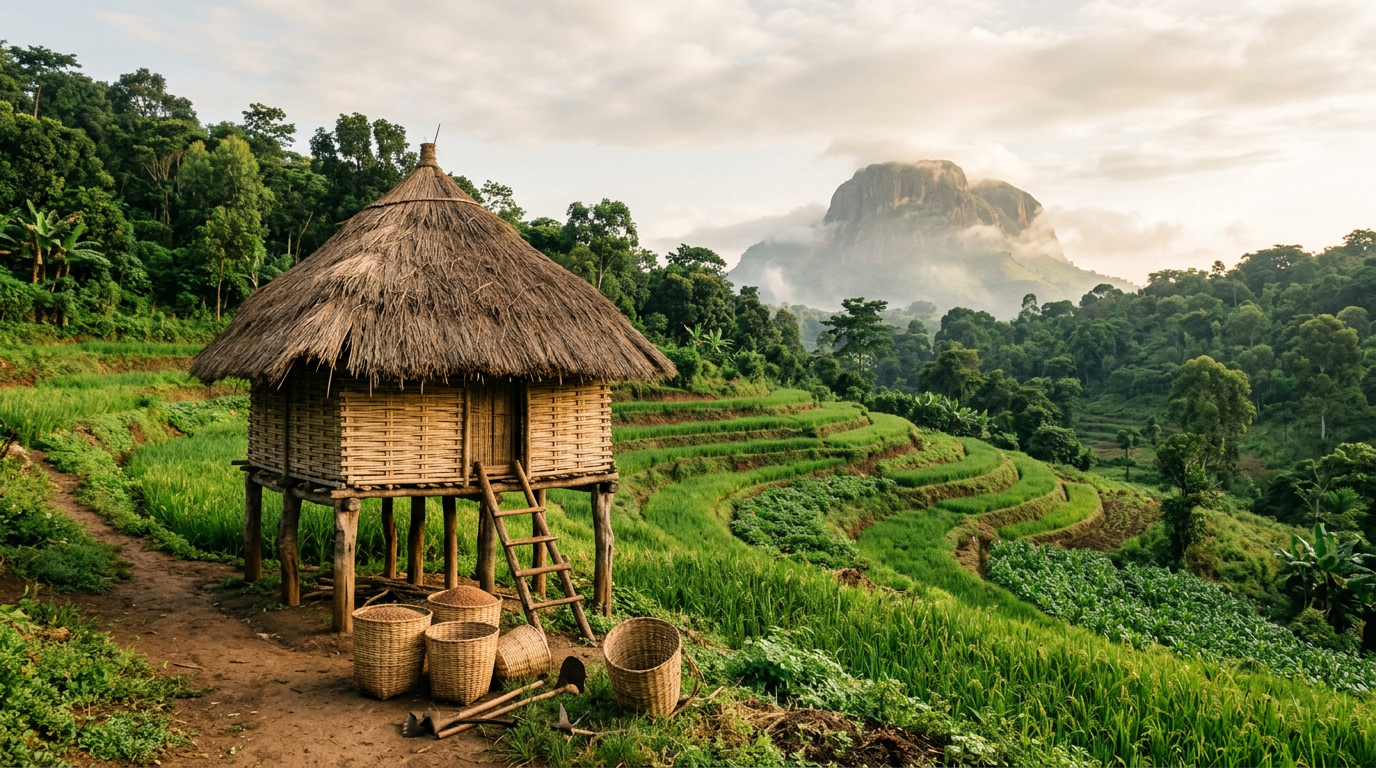
Raised granary
Millet-field green
The thatched granary that holds the finger-millet harvest, in the green of the farmland around Tororo.
Questions to ask an elder
Related Luo Nations
The Jopadhola descend from Luo migrants who moved south and east from present-day South Sudan and settled around Tororo from about the sixteenth century. Their founding ancestor is Adhola, and tradition names Owiny of the Kenyan Luo as his brother.
Surrounded by Bantu and Ateker neighbours, they kept the Dhopadhola language and customs, and over time incorporated Bantu, Iteso and other families into their clans. The archive records them as Luo by language and descent, with a mixed clan make-up.
Encyclopedia summary
The Jopadhola reached south-eastern Uganda in the 16th century after settling first in central Uganda, and chose forest land for protection. The Luo peoples article places them under a leader named Adhola at Budama between the mid-1500s and early 1600s. Accounts of the deeper origin differ.
Lead to check with Uganda elders and reviewers.
Encyclopedia summary
There are more than 52 clans, each with its own ancestry, lineage and customs. There was no single traditional government; the structure is described as semi-centralised.
Lead to check with Uganda elders and reviewers.
Encyclopedia summary
Each clan runs its own court, the koti, which combines leadership and judging. Members are balanced by age and gender through youth and women representatives, and are chosen for merit and their duties to kin. The legal scholar Maureen Owor sees this as a local form of judicial independence. Moses Stephen Owor is named as the Kwar Adhola (2017).
Lead to check with Uganda elders and reviewers.
Encyclopedia summary · Undated, historical
In the past marriages were arranged: with the girl’s parents’ agreement a boy’s father placed a bracelet on a baby girl’s wrist, and the families visited over the years. The source describes force being used if the girl resisted. This is a historical practice, recorded here to understand change, not as a custom to follow.
Lead to check with Uganda elders and reviewers.
Encyclopedia summary
The land is Padhola, which the historian Bethwell Ogot reads as “Pa Adhola”, the place of Adhola. The outside name “Badama” is said to come from Baganda mishearing the war cry “Widoma”. In Dhopadhola, jo- means people of, dho- language of, and pa- marks belonging.
Lead to check with Uganda elders and reviewers.
Encyclopedia summary
The article describes the Jopadhola as mainly pastoralists, without more detail. Farming and trade around Tororo need local research.
Lead to check with Uganda elders and reviewers.
Encyclopedia summary
Most Jopadhola live in Tororo District, eastern Uganda. The 2014 census counted 481,816.
Lead to check with Uganda elders and reviewers.
Dhopadhola is a Southern Luo language that Acholi, Alur and Dholuo speakers can largely follow. “Dho” means language of, and “Jo” means people of.
Read more on WikipediaWikipedia says the Jopadhola reached south-eastern Uganda in the 1500s and settled in forest country, which helped them keep their language and customs among Bantu neighbours.
Read more on WikipediaMore than 52 clans, with clan courts (koti). The Kwar Adhola is the cultural leader.
Read more on WikipediaTororo District in eastern Uganda.
Read more on WikipediaWikipedia has few articles on Jopadhola people yet. Suggest a person with a published source through Contribute.
Read more about the Jopadhola on WikipediaFreely licensed photos from Wikimedia Commons, each credited. Captions name only what the file says.
Checking the photo licences…
Achero pamunenwa kiyawi
“A gift from an intimate friend is never doubted”
Meaning not yet recorded. Ask an elder what it teaches.
From a single community social media post that tags a book by Prof. Olweny. Check the book.
Jopadhola
Visitors, gifts, friends and enemies
The Jopadhola collection has not started. Community members, researchers and families can help begin it.
Help start this collection