
Ngäc løw opäära adhuri ki yie.
“Know which side the cat jumps.”
Meaning: Weigh the pros and cons before you decide.
Anywaa (Ethiopia)
River people of the Sobat, across South Sudan and western Ethiopia.
A Northern Lwoo community and language across western Ethiopia and South Sudan. Contributors are asked which spelling and autonym their community prefers.
Other spellings and why
At a glance
The topics in the menu now show what is recorded for South Sudan, together with what all Anyuak homes share. Each record says which it is.
Open the South Sudan pageWhat is known so far, and what still needs research.One people, several spellings
Anyuak, Anywaa and Anuak are spellings of one name. The site uses Anyuak everywhere and lists the others, with the reason, behind the small “i” next to the name. If the community prefers another spelling, the whole site switches to it.
Emblem and colour
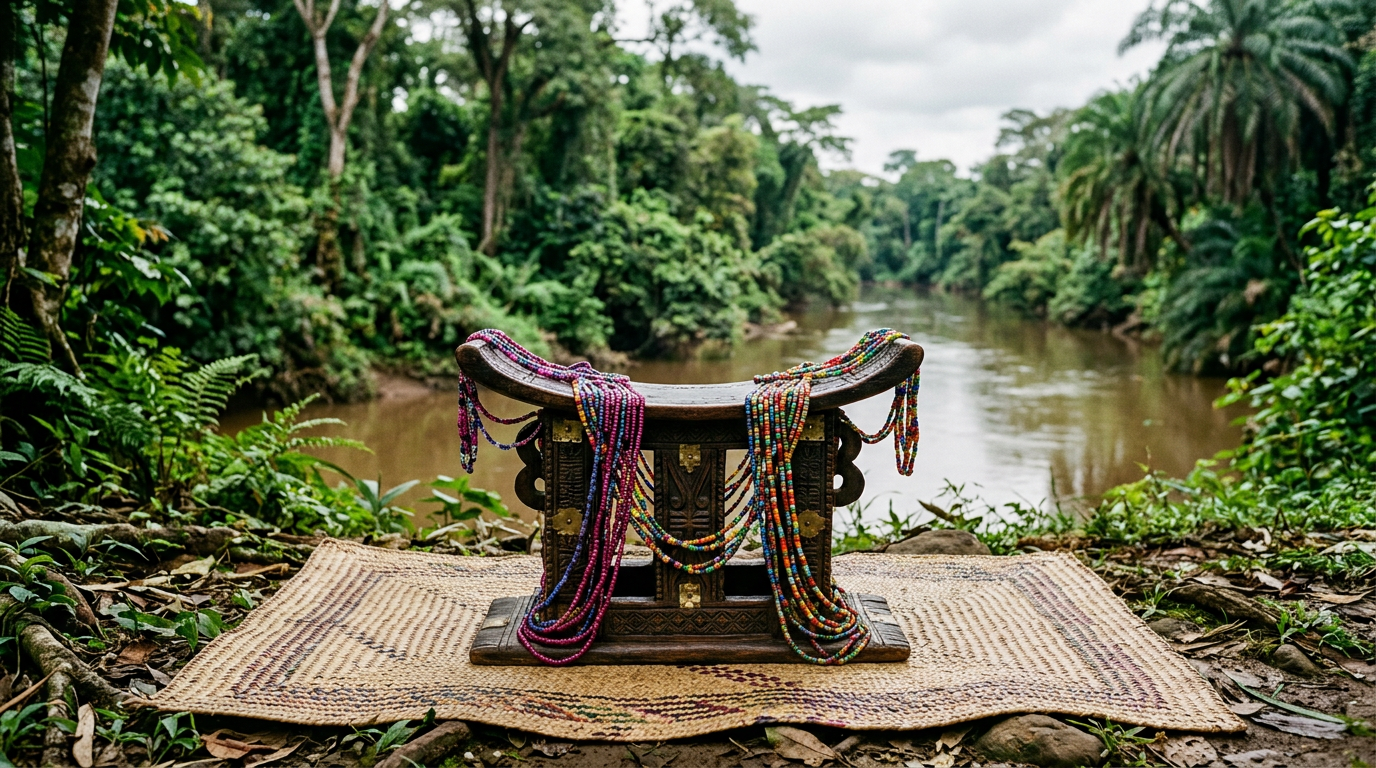
Beaded royal stool
Bead-string plum
The carved stool and glass beads of Anyuak chiefly regalia, in the deep plum of the bead strings.
Questions to ask an elder
Related Luo Nations
The Anyuak are a Nilotic Luo people. Ogot and later writers place their roots in the Gezira region of central Sudan, with southward and eastward movement between about the twelfth and fifteenth centuries to the Baro, Gilo and Sobat river lowlands.
They share close language and tradition with the Shilluk to the north and the Acholi to the south.
Shared by all homes · Encyclopedia summary
One account says Anywaa ancestors came from the Gezira, between the Blue and White Niles, and moved south and east between the 12th and 15th centuries to the Baro and Gilo lowlands. Its sourcing is thin (the nearby citation is a study of the Southern Luo), so treat it as a lead.
Lead to check with community elders and reviewers.
Shared by all homes · Encyclopedia summary
Villages are led by headmen whom the people can remove if they rule badly or act like dictators. The article describes an outlook that rejects leaders who claim to be god-like, and close, largely self-reliant villages.
Lead to check with community elders and reviewers.
Shared by all homes · Encyclopedia summary
Older Anywaa religion gave special weight to trees, and some villages kept holy trees; the almighty spirit was called Jwøk. Today many Anywaa are evangelical Christians.
Lead to check with community elders and reviewers.
Shared by all homes · Encyclopedia summary
Dha-Anywaa is a Western Nilotic Luo language spoken in western Ethiopia and South Sudan by about 220,000 people. It forms a dialect cluster with Päri and Jur-Luwo, has no fricative sounds and is written in Latin or Ge’ez script.
Lead to check with community elders and reviewers.
Shared by all homes · Encyclopedia summary
Most Anywaa farm for their own needs, with rivers at the centre of life. Sorghum and maize are the main crops; cattle, sheep and goats are kept but matter less than among neighbouring cattle peoples. Fishing, hunting and gathering fill out the diet; fish and maize have largely replaced the meat and honey of earlier times.
Lead to check with community elders and reviewers.
South Sudan · Encyclopedia summary
Anyuak in South Sudan live on flat, almost treeless grassland that floods in the rains into swamp cut by deep channels.
Lead to check with South Sudan elders and reviewers.
Shared by all homes · Encyclopedia summary
Ethiopia’s 2007 census counted 89,000 Anywaa and South Sudan’s 2008 census 165,000. Overall estimates run from 200,000 to 300,000.
Lead to check with community elders and reviewers.
Dha-Anywaa is a Luo language. It forms a dialect cluster with Päri and Jur-Luwo, and is written in both Ge’ez and Latin script.
Read more on WikipediaWikipedia traces Anyuak roots to central Sudan and a move to the Baro and Gilo rivers between the 1100s and 1400s. The 1902 Anglo-Ethiopian Treaty later cut their territory in two. Violence after 1991 pushed many abroad, notably to Minnesota.
Read more on WikipediaFarming, fishing and herding. Villages are led by headmen whom the people can remove.
Read more on WikipediaGambela Region in western Ethiopia, along the Baro and Akobo rivers, and neighbouring parts of South Sudan, with many families abroad, notably in the United States.
Read more on WikipediaWikipedia’s Anuak article has no list of notable people yet. These two articles say the person is Anyuak.
Read more about the Anyuak on WikipediaNgäc løw opäära adhuri ki yie.
“Know which side the cat jumps.”
Meaning: Weigh the pros and cons before you decide.
Anywaa (Ethiopia)
Dhir nywaak ba week dhöödhö.
“To share the food, prevent the calf from drinking the cow’s milk!”
Meaning: When everyone cooperates in farming, all share the benefit.
Anywaa (Ethiopia)
Dhira angany jaala wanni dëëri.
“The owner looks after Agany’s cow!”
Meaning: Each person should look after their own work.
Anywaa (Ethiopia)
Nyaang ba buut wøk jaak.
“A crocodile sleeps only on the river-banks!”
Meaning: Do not act without knowing how you would escape a bad result.
Anywaa (Ethiopia)
Nyaang caama dïpööy.
“Crocodile ate the teacher!”
Meaning: Said when a moral preacher is caught in immoral dealings.
Anywaa (Ethiopia)
Kar tier jwöthï japi.
“Don’t open your armpit.”
Meaning: Revealing your weaknesses to others is dangerous.
Anywaa (Ethiopia)
Gwök kwanynya ri wääth ki cöö.
“Unless the dog searches, it won’t get the bone!”
Meaning: You gain nothing unless you move and try.
Anywaa (Ethiopia)
Gwök ba guuyi jaak.
“A dog cannot bark at nothing!”
Meaning: What people say about someone usually has a reason.
Anywaa (Ethiopia)
Liec thöra apøøte.
“An elephant can be finished by taking it piece by piece!”
Meaning: Big work is finished bit by bit.
Anywaa (Ethiopia)
Atea dhie jeeya koodhi.
“The goat that ignores warnings gets the lesson from the thorns!”
Meaning: Ignore elders’ advice and you learn through suffering.
Anywaa (Ethiopia)
Angwala ni toor baam odiek.
“Hyena pretends as if its hip-bone is broken.”
Meaning: Do not imitate others; you will be caught.
Anywaa (Ethiopia)
Kwac kit moe ba wiile.
“A leopard can’t change its spots.”
Meaning: A hard-hearted person’s basic nature is hard to change.
Anywaa (Ethiopia)
Ocirö cäädhi ka akwaane.
“A tortoise walks with its shell!”
Meaning: Take what you need for a journey and do not rely on other people’s property.
Anywaa (Ethiopia)
Dhieng cwoba ri nyilaal.
“The cow struck the child.”
Meaning: Said of someone who hides their real need behind a made-up reason.
Anywaa (Ethiopia)
Luubö atimö ni cwiek tiedo.
“The speech is Tiedu’s soup.”
Meaning: Praise for a speech that is as pleasing and wholesome as good soup.
Anywaa (Ethiopia)
Gwök ma mägö ki lääy ngic ki tiete.
“A good hunting dog is identified by its legs!”
Meaning: You recognise a capable person by watching how they work.
Anywaa (Ethiopia)
Odiek pëëte nøk.
“Scarce are the hyena’s skins!”
Meaning: Fear stops people taking on dangerous tasks, yet overconfidence is dangerous too.
Anywaa (Ethiopia)
Ajwomi nø kwääka wï thuurë.
“Every monkey plays in its own place.”
Meaning: People are confident at home and powerless in a strange place.
Anywaa (Ethiopia)
Ajwom ba buut bäät cwa.
“The monkey won’t sleep on the tamarind tree.”
Meaning: Do not sleep beside your stores, or you will eat tomorrow’s food today.
Anywaa (Ethiopia)
Ngat dhee ongiic acela thaac waange waange ni kweelø.
“One has to burn even his grass-hat to taste the mouse-meat!”
Meaning: Use whatever you have, and act in good time, to gain what you want.
Anywaa (Ethiopia)
Kwøro wïïr ki maar dëërë.
“A musk-cat makes itself sweet smelling by its musk.”
Meaning: A person becomes known through their own gifts and should use them well.
Anywaa (Ethiopia)
Pääri ki dum kwøro kanyo poode ni kwac poot naanga ree.
“Jump with the wild musk-cat’s skin before the tiger licks its own skin!”
Meaning: Prepare well for small tasks before taking on bigger ones.
Anywaa (Ethiopia)
Obang ko Omøt gena apät cøøyø.
“Obang and Omot are intimate friends. The spoon and the fat of wild boar love each other.”
Meaning: Said of two friends who cannot be separated.
Anywaa (Ethiopia)
Aana purö ki puur kul.
“I tilled like a wild boar.”
Meaning: A farmer’s cry of despair after hard work brings nothing because the rain failed.
Anywaa (Ethiopia)
Døø wøk adhienga teek.
“The beer is difficult to strain.”
Meaning: Do not step into another group’s affairs or hospitality unless you are invited.
Anyuak (Ethiopia)
Looking before acting, avoiding traps
The Anyuak collection has not started. Community members, researchers and families can help begin it.
Help start this collection